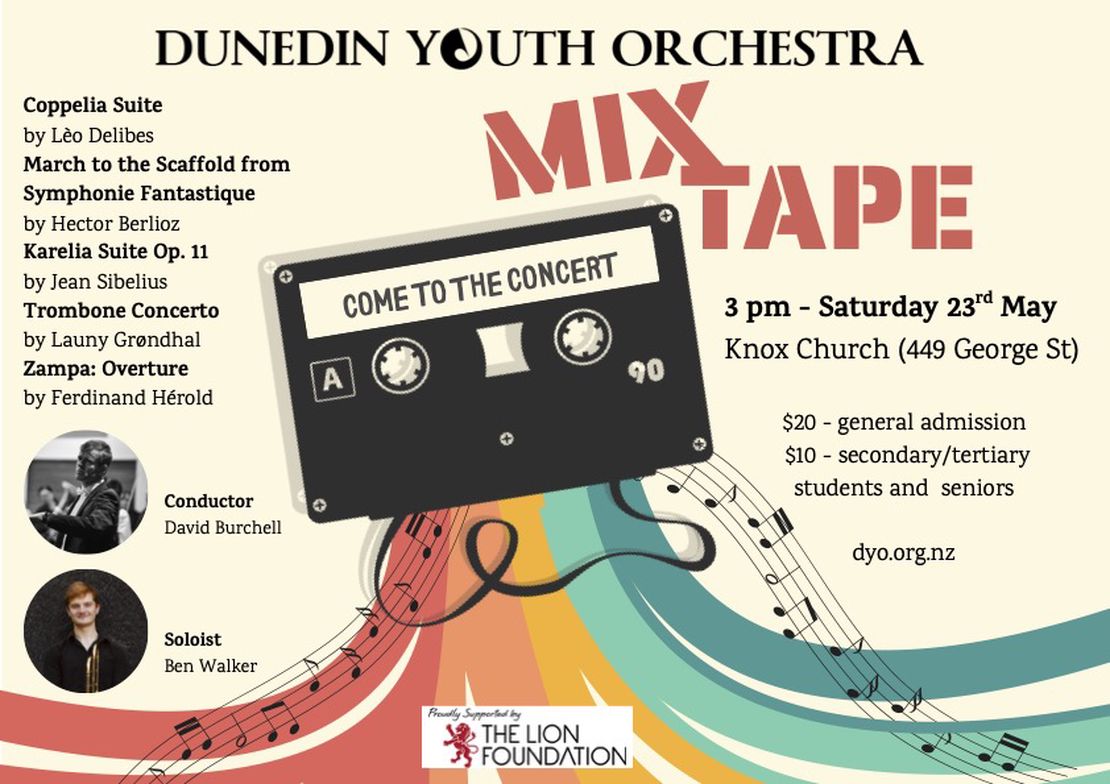
Mix Tape
- Saturday 23 May 2026, 3:00pm
- Knox Church
Great concert coming up!
Buy TicketsProgramme
- Zampa Overture
- Trombone Concerto
- Karelia Suite Op. 11
- March to the Scaffold
- Coppelia Suite
Zampa Overture
Composer: Ferdinand Hérold
Ferdinand Hérold was a French composer who lived from 1791 to 1833. He was an influential figure in his day, even inspiring the likes of Bizet and Wagner. The comic opera Zampa was composed near the end of Hérold’s life in 1831. It takes place in Southern Italy, starring the pirate Zampa. The opera is about Zampa trying to marry a woman called Camile, who is really in love with Zampa’s brother. Zampa also has to deal with a statue of his ex-lover that has come to life. The opera ends with Zampa being dragged down to hell by this statue.
The Overture to this opera sadly remains the only piece by Hérold that is commonly performed today. It has a driving opening with an accentuated second beat, followed by mysterious string tremolos and picturesque wind chords. There is then a chorale-like woodwind tune. After a transition section where the opening melody returns, there is a bombastic variation of the chorale melody. This is followed by a gorgeous clarinet solo. This beautiful moment is interrupted by a cartoonish violin and flute tune, which is quite an earworm. The overture ends with invigorating barrages of violin quavers and brass fanfares.
Written by James Hurley
Trombone Concerto
Composer: Launy Grøndahl
Soloist: Ben Walker
Ben Walker is a music student at the University of Otago, where he has been studying the trombone for the past few years. His musical journey began 14 years ago in his hometown of Timaru when he began lessons on the piano. Simultaneously, his twin began lessons on the Cornet, and out of ‘inspiration’ they both decided that they needed to learn each other’s instruments. In 2013, his twin began piano lessons, while Ben unfortunately began trombone lessons due to a shortage of cornets! However, he would eventually decide that he liked the trombone because his Dad also played the trombone. A short while later, he joined his school’s ensemble, the renowned Waimataitai Brass Band.
Moving forward in time, in 2018, Ben began his orchestral journey when he joined the South Canterbury Youth Orchestra. This led him to audition for the New Zealand Secondary Schools Symphony Orchestra, which he succeeded in doing in 2020 and 2021 on the bass trombone. After finishing his time with the Timaru Boys’ High School he decided to pursue further education in Dunedin. In 2022, he broke into the Dunedin music scene by successfully auditioning for the Dunedin Youth Orchestra and by joining a plethora of other ensembles. His proudest achievement so far has been successfully auditioning for the Dunedin Symphony Orchestra (DSO) in 2025. Amusingly (and terrifyingly), he had a “trial by fire” with the DSO where he had to play a short trombone solo in his very first ‘International’ concert!
Today, Ben can often be found in the practice rooms on campus where he prepares for his university recital as well as for concerts with the Kaikorai Metropolitan Brass Band, St Kilda Brass Band, Dunedin Symphony Orchestra, Dunedin Collegiate Orchestra and of course the Dunedin Youth Orchestra.
It is with great pleasure and trepidation that he has the fortune to play Launy Grondahl’s Trombone Concerto this evening. He chose this piece because it is one of the very few Romantic styled Trombone Concertos in the trombone repertoire. Furthermore, this piece focuses on the lyrical and dramatic capacities of the trombone, thus making it an excellent match to Ben’s strengths on the trombone.
Karelia Suite Op. 11
Composer: Jean Sibelius
Intermezzo
Ballade
Alla Marcia
Written in 1893 by Finnish composer Jean Sibelius. The three movements of this piece are originally derived from the larger “Karelia Music,” which Sibelius composed on a commission from a Helsinki University student pageant.
The piece presented a series of historical musical tableaux representing and celebrating Finnish culture, specifically that of the Karelia region. At the time the suite was written, Finland was under Russian rule. The piece focuses so heavily on the promotion of Finnish culture and use of Karelian folk elements that it is seen as a cry for freedom, a nationalistic cultural resistance to the Russian empire in response to the oppression against Finnish culture. It highlights the rich history of Finland, asserting that the Russian empire can never truly erase Finnish culture.
I think that the Karelia Suite is an important piece for the Dunedin Youth Orchestra to play as it highlights the power and influence that music holds, which is crucial for us to remember in today’s context. With the seemingly endless cycle of oppression, violence, and tyranny that we seem so helplessly stuck in, it is important for us to remember that music, which we often take for granted, has the power to unify and inspire people to stand up against the powers that seem so much bigger than ourselves.
Written by Louis Calder
March to the Scaffold
Composer: Hector Berlioz
March to the Scaffold, taken from the Symphonie Fantastique by French composer Hector Berlioz, is a favourite among players and audiences alike; performed in the past by the DYO as well as last year by the Dunedin City Wind Orchestra.
It is the 4th of the symphony’s 5 movements; a symphony telling the story of an artist becoming obsessed with a woman to the point of delirium and hallucination. Compared to the joyful first three movements, the 4th depicts the artist dreaming he has murdered his beloved, now being Marched to the Scaffold for his execution!
A dramatic march, driven by the snare drum and bolstered by the brass, is suddenly interrupted by a solo clarinet recalling the ever-constant idée fixe… the symphony has been likened to a cinematic film score, but in a period before movies existed, making it a standout composition of its time!
Written by Nikhil Rawat
Coppelia Suite
Composer: Lèo Delibes
Entr’acte and Valse
Prelude and Mazurka
Ballade and Theme Slave Varie
Valse de la Poupee
Csardas
Coppelia Suite is originally from a ballet choreographed by Arthur Saint-Leon to the music of Leo Delibes. The ballet was inspired by the dark short story Der Sandmann (The Sandman) by E.T.A Hoffmann. Coppelia premiered in 1870 with 16-year-old Giuseppina Bozzacchi playing the principal role. Its success was interrupted by the Franco-Prussian War and the Siege of Paris, which led to Bozzacchi’s death on her 17th birthday. The story the ballet follows is about Dr Coppelius, who made a life-size dancing doll.