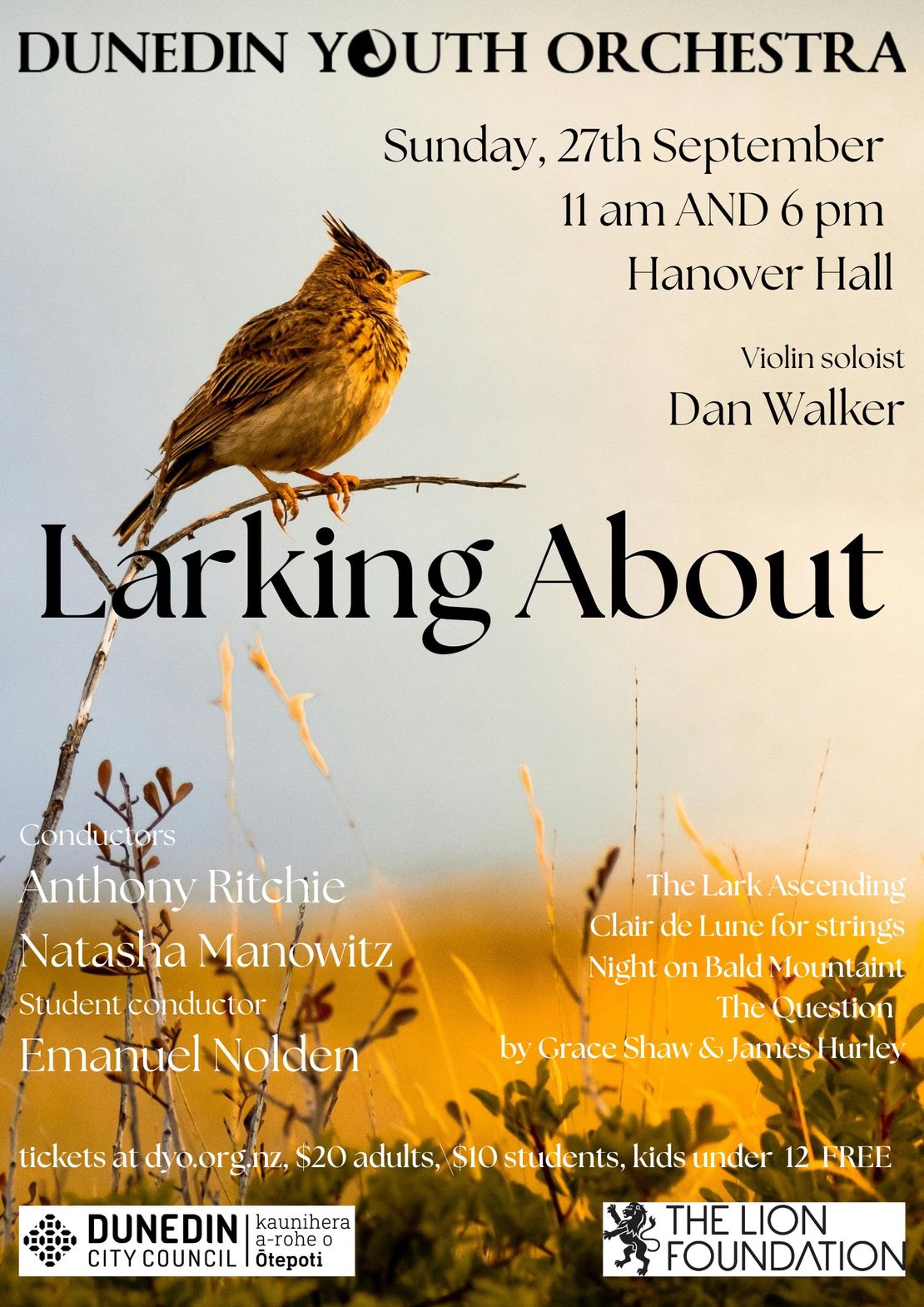
Larking About
Sunday 27 September 2026, 11:00am
Sunday 27 September 2026, 6:00pm
- Hanover Hall
This concert has taken place. Read the review.
Programme
- Symphony No. 1 ‘Boum’
- Clair de Lune
- Night on Bald Mountain
- The Lark Ascending
- Slavonic Dance No. 8
- A Question
- Symphony No. 9
Symphony No. 1 ‘Boum’, II allegro energico (1993)
Composer: Anthony Ritchie
The title ‘Boum’, comes from an ominous tam tam stroke that recurs frequently through the symphony. It represents a mysterious echo heard by two of E M Forster’s characters in the novel ‘A Passage to India’ when they investigate the Marabar Caves. This sound comes to symbolise the mysteries of life and death in the novel. We hear the ‘boum’ played loudly on tam tam in the middle of this second movement. It is lively and bright and also features the sounds of the Cook Islands log drum. The log drum and tom toms punctuate the movement’s textures and create a sense of propulsion. There is a folksy theme played on string quartet and flutes in the middle that offers contrast. A soaring melody on strings appears later, quoted from the first movement, before the music builds to an exciting climax.
Written by Anthony Ritchie
Clair de Lune (for strings)
Composer: Claude Debussy
Arranged by John Drummond
Clair de Lune, translated to ‘moonlight’ in French, was written for piano. The piece was composed by Claude Debussy in 1905 and was inspired by a poem of the same name penned by Paul Verlaine:
Your soul is a chosen landscape
Where charming masqueraders and bergamasquers go
Playing the lute and dancing and almost
Sad beneath their fanciful disguises.
…and their song mingles with the light of the moon,
The calm light of the moon, sad and fair,
that sets the birds dreaming in the trees
…
Clair de Lune is the third movement of the four-part Suite Bergamasque, becoming remarkably popular independent of its sibling movements. The piece brilliantly captures the feeling of moonlight, with the space created between the chords, and the delicate melody flowing throughout. Dunedin Youth Orchestra will be playing an arrangement of Clair de Lune written for chamber orchestra by John Drummond.
Written by Clara Satherley
Night on Bald Mountain
Composer: Modest Mussorgsky
Arranged by Nikolai Rimsky-Korsakov
Conducted by Natasha Manowitz (guest conductor)
Night on Bald Mountain by Modest Mussorgsky (1839–1881) tells of a wild supernatural gathering on Bald Mountain on the eve of St John’s Day. Witches and dark spirits gather for a frenzied celebration. You’ll hear fierce, driving rhythms, dramatic brass and percussion, swirling orchestral textures and sudden contrasts. The ending brings the arrival of a new day, with church bells announcing the dawn and the spirits dispersing. Mussorgsky was a Russian composer and member of “The Five”, a group who sought to create a distinctly Russian musical style. Their members were Mily Balakirev, César Cui, Modest Mussorgsky, Nikolai Rimsky-Korsakov and Alexander Borodin. Tonight’s version was arranged by Nikolai Rimsky-Korsakov after Mussorgsky’s death and became the work’s best-known orchestral version.
Written by Natasha Manowitz
The Lark Ascending
Composer: Ralph Vaughan Williams
Soloist: Dan Walker (violin)
Ralph Vaughan Williams was an English composer born in 1872 whose work is well known to this day. His style, influenced by Tudor music and English folk-songs, marked a break from the previous German dominated style prevalent in English music of the 19th century. Vaughan Williams was also taught briefly by Ravel in 1907–1908 although he himself said of Vaughan Williams that he was “my only pupil who does not write my music”. Vaughan Williams’ ‘The Lark Ascending’ is a single movement romance for violin and orchestra composed in 1914. The piece is one of his best known works and is inspired by the poem of the same name by George Meredith, of which an excerpt was included at the head of Vaughan Williams’ score. The Lark Ascending’s publication was interrupted by the First World War where Vaughan Williams served in France and Greece in the Royal Army Medical Corps. This interruption meant that the first performance of ‘The Lark Ascending’ was in 1920, with the first orchestral performance taking place in 1921. It is a piece full of idyllic and pastoral melodies and ancient folk melodies, but it also has an underlying sadness and nostalgia for simpler pre-war times.
He rises and begins to round,
He drops the silver chain of sound,
Of many links without a break,
In chirrup, whistle, slur and shake.For singing till his heaven fills,
’Tis love of earth that he instils,
And ever winging up and up,
Our valley is his golden cup
And he the wine which overflows
to lift us with him as he goes.Till lost on his aerial rings
In light, and then the fancy sings.
Written by Dan Walker
About the soloist
Dan Walker is in his 4th year studying Music and Neuroscience at the University of Otago. He started learning violin when he was five in Wellington, and in high school he played in the Wellington Youth Sinfonietta and Orchestra and was concertmaster of his high school orchestras. Dan has been a member of DYO since 2023 and the DSO since 2025. He currently studies under Tessa Petersen and won the Alice Kirscher prize in music at Otago in 2025.
Alongside his studies, he teaches for SMMC and plays with the Kā Tiritiri o te Moana string quartet.
Slavonic Dance No. 8
Composer: Antonín Dvořák
Conducted by Emanuel Nolden (student conductor)
Dvořák’s Slavonic Dance No. 8 is a well-known segment from a set of 16 pieces. Inspired by the Hungarian Dances of Johannes Brahms, the dances were originally written for piano duet in the late 1880s and published as two sets. No. 8 is the last of the first set. Whilst Brahms used existing tunes, Dvořák wrote his own based on folk songs and the characteristics of dance rhythms. No. 8 is based on the furiant, a popular Bohemian pairs dance of the 19th century. Like the furiant, Dvořák’s energetic dance hides the ¾ time signature through hemiolas (a feeling of two, in a pulse of three) and syncopation (off-beat rhythms) amongst fiery energy, repeated musical ideas and the contrast between major and minor reiterations of the theme.
Written by Ellen Walters
A Question
Composers: James Hurley & Grace Shaw
2026 Anthony Ritchie Composition Award
A Question is a short, four-movement “Symphonini” written in collaboration between composers Grace Shaw and James Hurley. James initially wrote movements 2 and 3, while Grace wrote 1 and 4. The composers then exchanged the raw files and allowed each other complete creative control in editing and orchestrating. The composers restricted each movement to a maximum of 32 bars, challenging themselves to create cohesive musical ideas in very few bars (the equivalent of 4 8-bar phrases). Each movement symbolises a different section of the titular question: “Have you ever stopped for a second and just let the world pass you by?” It is written with the intent to allow the audience a moment to sit and reflect: have you stopped for a second recently?
Written by Grace Shaw
Symphony No. 9, I Andante - Allegro
Composer: Franz Schubert
Schubert’s Symphony No. 9 in C major (also known by its nickname “The Great”) was the last symphony he composed. Although it was finished in 1825, the symphony was not publicly performed until 1839 — more than ten years after Schubert’s death. The Andante opening movement begins with the main theme, which undergoes a few variations before we are launched into the movement’s energetic fast section, characterised by sudden orchestral bursts and quick dashes into E major, E minor and A-flat major. This intensity is sustained throughout the rest of the movement, until the initial theme returns at the end.
Written by Maddie Carter
Thank you to our sponsors Lion Foundation, Aotearoa Gaming Trust, and Heffs Hotel!
Review
An orchestra has four families of instruments – strings, woodwinds, brass and percussion. Playing together they charm and beguile, combining to create beautiful sounds which portray peace and power – lullabies and tsunamis that fill our ears with ease and power.
The Dunedin Youth Orchestra concert of 27/09 began with Anthony Ritchie’s ‘Boum’ conducted by the composer. An initial, startling wallop of the tam-tam sets off scurrying to and fro of strings and side drum. Some majestic antiphonal interplay between massed strings, brass and woodwinds and later some lovely solos for 1st and 2nd violins, flute, piccolo, saxophone and bassoon. Thus the orchestra introduced itself and warmed up the audience. Debussy’s familiar Clair de Lune followed, played by the strings alone in an arrangement by John Drummond’s. Debussy’s harmonic palette sounded even more lush and extravagant in this guise. Sensitive playing by the strings created a lovely atmosphere – calm before the storm of Night on Bald Mountain. Mussorgsky created a sinister atmosphere with every strange interval in the strings and brass figures as this tone poem gets underway. Natasha Manowitz puts it well: (a piece of) “ … frenzied celebration … fierce, driving rhythms, dramatic brass and percussion, swirling orchestral textures and sudden contrasts.” She managed to keep all the primitive tunes together and tidy. The welcome peace that finally arrives with the church bells ringing also featured a lovely flute solo singing out.
Congrats to Dan Walker for his performance of The Lark Ascending. His quiet opening cadenza was beautifully realized with silky tone and sensitive inflection – intonation clean and true. The orchestral accompaniment gave satisfying support while floating along with an unhurried sense of direction. This all came across as sophisticated and soulful – a delight throughout!
Dvorak Slavonic Dance No.8 is a blast of energy and verve with its rhythmic drive and good cheer. Emanuel Nolden was the confident conductor – steady, bold and sensitive by turn as needed. The orchestra seemed happy and relaxed, enjoying themselves to the hilt.
James Hurley and Grace Shaw’s collaboration A Question was the next piece in the puzzle of Ying and Yang – balancing old and new to hold the audience. It did succeed in holding my interest, firstly because of its unusual partnership in the composition process and secondly because of the quality of its inventiveness of textures, contrasts, musical ideas, snippets of themes, etc. There were quirky bits and moments where things coalesced to produce some power. To accomplish all these qualities in four movements of 32 bars each is very cool.
The 1st mov’t of Schubert’s Great Symphony in C for the concert finale was a very satisfying and astute choice, bringing us back to the most basic key centre and the time period when the Classical orchestra became standardised. The introductory Andante tested the intonation of winds and strings reminding us that this is a young orchestra of capable players who are learning as they gain wonderful experience. The Allegro that follows exudes a cheerful bonhomie that lifted spirits and brought smiles. To perform this lengthy programme twice in one day must have been a challenge for focus and stamina for all. When the music stopped the audience cheered and applauded long and loudly in admiration and appreciation.
The DYO is a whānau and works as a loving family should. The brothers and sisters support each other. The older members mentor and help the younger and less experienced players. Seeing and hearing the results of their cooperation in concert is the supreme gift that these DYO occasions give us.
Thank you conductors, teachers, parents and most of all, the players
— JVB